I am seeking treatment for


Gaming Disorder in Singapore: Signs in Teens and Young Adults, and What Helps
November 22, 2026
Written and clinically reviewed by Adjunct Professor Dr Prem Kumar Shanmugam, founder of Solace Asia. November 2026.
Key takeaways
- Help for gaming addiction Singapore families can use includes NAMS for ages 13 and over, TOUCH’s DigitalMINDSET for ages 12 to 25, and school counsellors.
- Under the WHO’s ICD-11, gaming disorder means losing control over gaming, putting it first and carrying on despite harm, normally for at least 12 months.
- In a 2025 study of 1,008 young adults in Singapore, surveyed in 2023, 5.0% met the criteria for gaming disorder.
- In paid games offered in Singapore, loot box prizes must be mainly for use in the game and cannot be swapped for money.
- Start with TOUCHline, 1800 377 2252, or a NAMS assessment on 6389 2200. Other numbers are in our guide to addiction helplines in Singapore.
Quick answer
Gaming disorder means a person cannot control their gaming, lets it push out the rest of life and keeps going despite harm, usually for a year or more (WHO). Most people who game a lot do not have it. For gaming addiction Singapore offers NAMS assessments from age 13 (6389 2200), TOUCH’s DigitalMINDSET counselling for ages 12 to 25 (1800 377 2252) and school counsellors.
What is gaming disorder?
Gaming disorder, often called video game addiction, is listed in ICD-11, the World Health Organization’s classification of diseases. The WHO describes three features: impaired control over gaming, gaming taking priority over other interests and daily activities, and carrying on or playing more despite negative consequences. The pattern has to be serious enough to harm family life, friendships, study or work, and would normally have been present for at least 12 months. The WHO says studies suggest it affects only a small proportion of people who play (WHO).
So the hours matter less than the effect on the rest of life. Can they stop, and are they still sleeping, studying and seeing friends? Our earlier article on when a gaming hobby becomes a disease lists more warning signs.
Gaming addiction Singapore: what the research shows
In 2023, researchers led by James Cook University Singapore surveyed a representative sample of 1,008 young adults aged 18 to 40. Their 2025 paper found 5.0% met the criteria for gaming disorder and 10.3% for internet gaming disorder, the version in the American DSM-5 manual (Chew et al., 2025). Men were affected more than twice as often as women, and those affected reported more anxiety and poorer sleep (JCU Singapore, March 2025; The Straits Times via ANN, February 2026).
For children, a 2011 study followed 3,034 Singapore pupils in Primary 3 and 4 and Secondary 1 and 2 for two years and found about 9% were pathological gamers, with depression, anxiety and weaker school results tending to follow (Gentile et al., 2011). Phones add to the picture: an IMH survey run from 2021 to 2022 found problematic smartphone use in 46.4% of 15 to 21-year-olds (Subramaniam et al., 2024; The Straits Times via ANN, July 2024). Read the signs of an internet addiction.
TOUCH Community Services saw about 111 cases of excessive device use in 2022, up from 70 in 2019, and WE CARE reported over 20% more gaming referrals after the pandemic (The Straits Times via ANN, November 2024). Agencies reporting to the National Council of Social Service (NCSS) saw more than 780 new behavioural addiction cases in 2024, against over 520 in 2020 (NCSS, August 2026).
Associate Professor Peter Chew, who led the 2025 study, said games and social media are easier to reach in Singapore than alcohol or gambling.
“When people are stressed, they will look for forms of escape.”
Peter Chew, Associate Professor of Psychology, James Cook University Singapore. The Straits Times via ANN, February 2026
Signs of gaming addiction in teens and young adults
These signs draw on the WHO definition, NCSS and TOUCH.
| Healthy gaming | Worrying signs | What to do |
|---|---|---|
| Stops when time is up | Tries to cut down and cannot | Agree limits together and keep a log for two weeks |
| Still studies, works and sees friends | Skips school or work, drops hobbies, avoids family | Speak to the school counsellor |
| Mood is fine away from the game | Irritable, restless or angry when not playing | Book an assessment at NAMS or CHAT |
| Small, agreed spending | Large or hidden spending, or betting with skins | Remove saved cards; call the gambling helpline |
| Accepts the Wi-Fi going off | Threats of self-harm, or running away | Call SOS on 1767; in danger, call 995 |
TOUCH has seen young people threaten suicide when their parents turned off the home Wi-Fi, or run away when stopped from playing (The Straits Times via ANN, November 2024). Reactions like these need professional help straight away.
Worried about yourself or someone you love?
- A free, confidential first conversation
- Assessment by Solace Asia’s clinical team in Kuala Lumpur
- Residential and online programmes
Loot boxes, skins and gambling-like features
A loot box is an in-game purchase with a random prize inside. In a 2018 survey of 7,422 gamers, the more people spent on loot boxes, the more severe their problem gambling tended to be, though the authors could not say which came first (Zendle and Cairns, 2018). TOUCH has seen a 12-year-old spend S$10,000 in one month on items in his games (The Straits Times via The Star, August 2026).
In Singapore, chance-based loot boxes are not treated as gambling as long as players cannot exchange prizes for real-world payouts such as money or merchandise (MHA, March 2022). In paid games, prizes must be designed mainly for use in the game and cannot be redeemed for money (MHA, February 2025). In September 2025 the Home Affairs Minister said MHA and the Gambling Regulatory Authority would review showing the odds and requiring parental consent (MHA, September 2025).
Betting with skins, or any in-game item that can be sold for money, is different. MHA says games of chance where players can win money, its equivalent or any item of value come under the Gambling Control Act 2022 (MHA, Ask.gov.sg). For skins betting, the National Problem Gambling Helpline, 1800-6-668-668, is open 8am to 11pm daily (NCPG). Our article on betting addiction in Singapore explains the signs.
How to help a child addicted to games
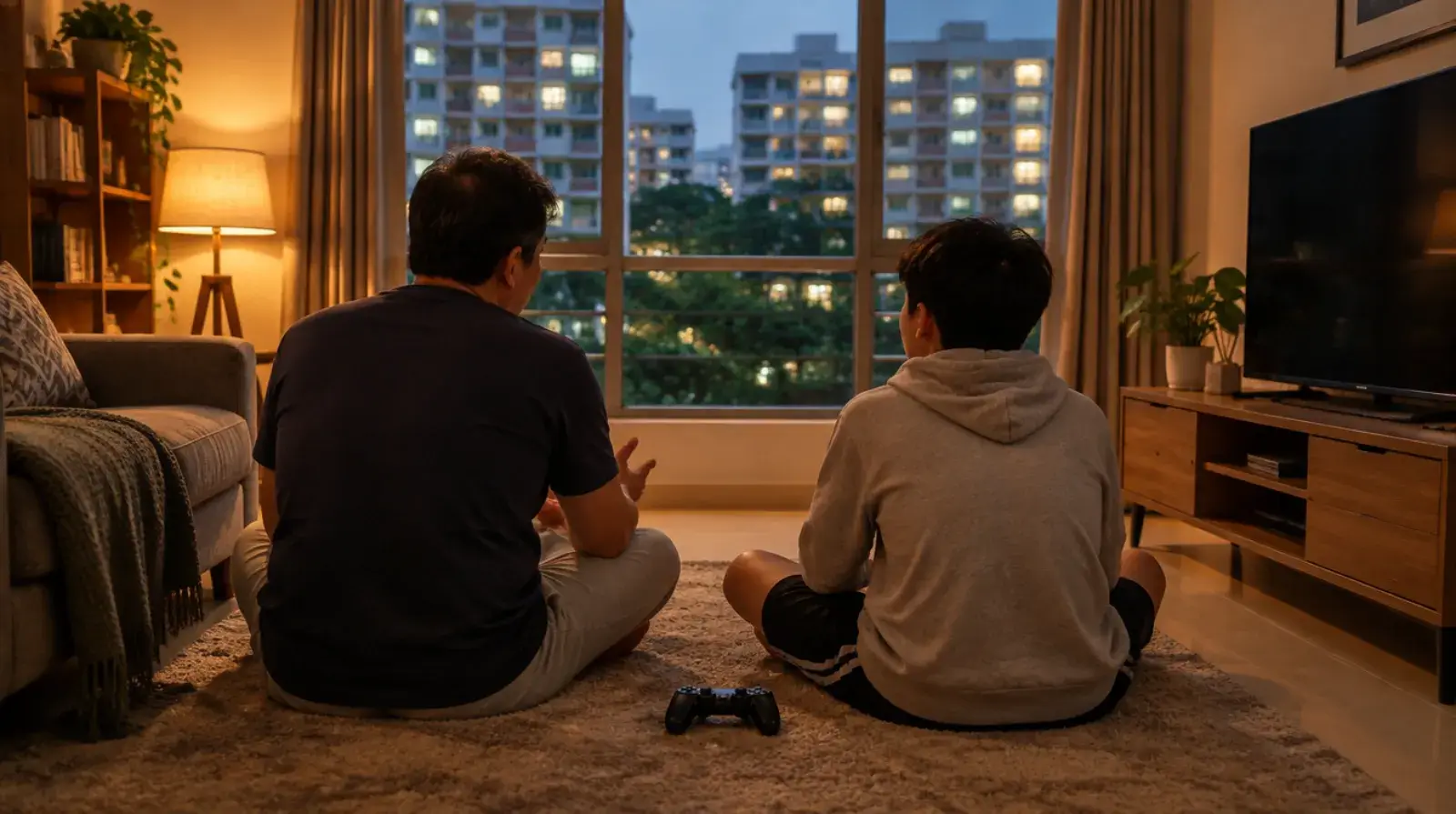
Talk at a calm moment and ask what the game gives them. Set rules together and follow them yourself: WE CARE’s clinical director said parents should take an active part in managing and modelling healthy device use (November 2024). Youth workers at Impart said young people also need third spaces, places beyond home and school where they feel seen (February 2026).
Involve the school. MOH says schools and institutes of higher learning have counsellors and peer supporters who encourage young people to seek help (MOH, September 2024). Get support for yourself as well. NAMS runs H.E.A.R.T., three online evening sessions for parents of 13 to 21-year-olds, and its Family Matters counselling is open to relatives even if the young person is not in treatment (NAMS). Our family workshop is another option.
Where to get help in Singapore
- NAMS, at the Institute of Mental Health, treats excessive gaming in young people aged 13 and over and may work with the school counsellor. Under-21s need a parent’s consent, and under-13s go to the Child Guidance Clinic (NAMS). Book on 6389 2200. Subsidised fees need a referral from a polyclinic, CHAS clinic or public hospital (NAMS).
- TOUCH’s DigitalMINDSET is a 6 to 9-month programme for 12 to 25-year-olds, with one-to-one, family and group sessions. Call TOUCHline on 1800 377 2252, weekdays 9am to 6pm (TOUCH).
- Ten ASPIRE centres, including WE CARE, offer behavioural addiction support in an NCSS pilot. Fees vary and some sessions are free (NCSS).
- CHAT, IMH’s youth mental health service for 16 to 30-year-olds, offers walk-in assessments at *SCAPE in Orchard (6493 6500; IMH).
Cognitive behavioural therapy (CBT) teaches people to notice the triggers behind the urge to play and to cope differently. A 2019 review of 12 studies found it reduced gaming disorder symptoms, depression and anxiety by the end of treatment, though the gains were not statistically clear at follow-up (Stevens et al., 2019). In a Geneva trial with 42 adolescents, family therapy reduced the disorder over a year, and one structured type, multidimensional family therapy, kept more families in treatment (Nielsen et al., 2021). Anxiety or low mood alongside a gaming problem is known as a dual diagnosis, and both need treating together.
A real story
A secondary school student told TOUCH he had gamed since he was seven, and by Primary 5 his screen time had reached nine to ten hours a day. His grades fell, he nearly had to repeat Secondary 1, and arguments at home became frequent. In Secondary 2, after his teacher stepped in, he was referred to DigitalMINDSET. His counsellor gave his parents ways to support him, and he took up running and strength training. He has since finished the programme, and his daily phone use has fallen from about ten hours to two or three. (TOUCH Community Services, December 2024)
Different views: is gaming disorder over-diagnosed?
Before ICD-11 was finalised, scholars led by Espen Aarseth called a formal diagnosis premature, citing weak research, and warned it would wrongly label children who game as part of a normal, healthy life (Aarseth et al.). A group led by Hans-Jürgen Rumpf replied that the decision rested on clinical evidence and public health needs, and would make treatment easier to get (Rumpf et al., 2018). The Singapore study shows why the definition matters: the DSM-5 measure counted about twice as many young adults as the WHO’s.
When residential care may help a young adult
For teenagers, help close to home and school makes sense. For a young adult, a residential stay may be worth discussing if outpatient help has not worked, or if gaming comes with depression, anxiety, drinking or drug use. Solace Asia in Kuala Lumpur is one option. Our 28-day primary programme includes one-to-one counselling, CBT and family therapy, and our 18-month aftercare continues online. Back in Singapore, follow-up can carry on with NAMS, TOUCH or an ASPIRE centre.
When to get help urgently
- If anyone talks about suicide or self-harm, call Samaritans of Singapore on 1767 or WhatsApp 9151 1767, both 24 hours. If someone is in immediate harm, call 995 or go to the nearest A&E (SOS).
- For mental health support at any hour, call national mindline 1771 or WhatsApp 6669 1771 (MOH, June 2025).
Frequently asked questions
Is gaming addiction a real diagnosis?
Yes. The WHO lists gaming disorder in ICD-11, though it affects only a small proportion of people who play.
How many hours of gaming is too much?
The WHO definition sets no number of hours. Look at whether the person can stop and whether school, work, sleep and friendships still happen.
Where can I get help for gaming addiction in Singapore?
NAMS sees young people aged 13 and over (6389 2200). TOUCH runs DigitalMINDSET for ages 12 to 25 (1800 377 2252). ASPIRE centres and CHAT, for ages 16 to 30, can also help.
Are loot boxes gambling in Singapore?
Singapore does not treat chance-based loot boxes as gambling if prizes cannot be exchanged for money or merchandise. Games of chance where players can win money or items of value come under the Gambling Control Act 2022.
Talk to us
If gaming has taken over your life or your child’s, and local help has not been enough, contact the Solace Asia team for a free, confidential consultation. If cost is a concern, our sister retreat Salus offers residential treatment at a lower cost, in a different residential location, maintaining Solace’s clinical standards for treatment.
References
- World Health Organization, “Addictive behaviours: Gaming disorder” (questions and answers), 22 October 2020. who.int/news-room/questions-and-answers/item/addictive-behaviours-gaming-disorder
- Chew PKH, Naidu KNC, Shi J, Zhang MWB, “Prevalence and correlates of (internet) gaming disorder among young adults in Singapore”, Psychiatric Quarterly, 2025. DOI 10.1007/s11126-025-10119-9. researchonline.jcu.edu.au/84645
- James Cook University Singapore, “Gaming and Internet Gaming disorders: A growing concern for young adults in Singapore”, 28 March 2025. jcu.edu.sg/news/releases
- The Straits Times via Asia News Network, “Problematic gaming prevalent among young adults in Singapore, shows need for ‘third places’: Experts”, 2 February 2026. asianews.network/problematic-gaming-prevalent-among-young-adults-in-singapore
- Gentile DA, Choo H, Liau A, Sim T, Li D, Fung D, Khoo A, “Pathological video game use among youths: a two-year longitudinal study”, Pediatrics 127(2), 2011. research.polyu.edu.hk/en/publications
- The Straits Times via Asia News Network, “About one in two young Singaporeans has problematic smartphone use: IMH study”, 29 July 2024. asianews.network/about-one-in-two-young-singaporeans
- Subramaniam M et al., “Problematic smartphone use and mental health outcomes among Singapore residents: The health and lifestyle survey”, Asian Journal of Psychiatry 98, 104124, 2024. pesquisa.bvsalud.org/sms/resource/pt/mdl-38936322
- The Straits Times via Asia News Network, “More teens in Singapore getting hooked on digital devices and seeking help”, 14 November 2024. asianews.network/more-teens-in-singapore-getting-hooked-on-digital-devices
- National Council of Social Service, media release “NCSS Partners 10 Agencies to Help Individuals Experiencing Behavioural Addictions”, 20 August 2026. isomer-user-content.by.gov.sg (NCSS media release PDF)
- National Council of Social Service, “Behavioural addiction support”, accessed November 2026. ncss.gov.sg/research-and-insights/community-resources/behavioural-addiction-support
- TOUCH Community Services, “DigitalMINDSET Intervention Programme”, accessed November 2026. touch.org.sg/get-assistance/counselling-and-mental-wellness
- Zendle D, Cairns P, “Video game loot boxes are linked to problem gambling: Results of a large-scale survey”, PLOS ONE, 21 November 2018. journals.plos.org/plosone
- The Straits Times via The Star (ANN), “Singapore’s National Council of Social Service to spend S$5.6mil to get more agencies to help gaming, porn and gambling addicts”, 20 August 2026. thestar.com.my/aseanplus/aseanplus-news/2026/08/20
- Ministry of Home Affairs, “Gambling Control Bill and Gambling Regulatory Authority of Singapore Bill: Wrap-up speech by Mr Desmond Tan, Minister of State”, 11 March 2022. mha.gov.sg/media-room/newsroom
- Ministry of Home Affairs, written reply on regulating loot boxes in video games, 4 February 2025. mha.gov.sg/media-room/newsroom/regulating-lootboxes-in-video-games
- Ministry of Home Affairs, written reply on probability disclosure and parental consent for loot boxes, 23 September 2025. mha.gov.sg/media-room/newsroom
- Ministry of Home Affairs (Ask.gov.sg), “Are loot boxes in online games regulated in Singapore?”, accessed November 2026. ask.gov.sg/mha/questions/cmqu6lgkb007t440106p2n1x6
- National Council on Problem Gambling, home page, accessed November 2026. msf.gov.sg/ncpg
- Ministry of Health, “Whole-of-society efforts to support mental health and well-being of youths in Singapore”, 19 September 2024. moh.gov.sg/newsroom
- National Addictions Management Service, “Our Services”, accessed November 2026. nhghealth.com.sg/imh/nams/our-services
- National Addictions Management Service, “Contact Us”, accessed November 2026. nhghealth.com.sg/imh/nams/contact-us
- Institute of Mental Health, “CHAT: Centre of Excellence for Youth Mental Health”, accessed November 2026. nhghealth.com.sg/imh/chat
- Stevens MWR, King DL, Dorstyn D, Delfabbro PH, “Cognitive-behavioral therapy for Internet gaming disorder: A systematic review and meta-analysis”, Clinical Psychology and Psychotherapy 26(2), 2019. researchnow.flinders.edu.au/en/publications
- Nielsen P, Christensen M, Henderson C, Liddle HA, Croquette-Krokar M, Favez N, Rigter H, “Multidimensional family therapy reduces problematic gaming in adolescents: A randomised controlled trial”, Journal of Behavioral Addictions 10(2), 2021. real.mtak.hu/139964
- TOUCH Community Services, “Breaking Free from Gaming Addiction”, 12 December 2024. touch.org.sg/about-touch/community-stories/breaking-free-from-gaming-addiction
- Aarseth E et al., “Scholars’ open debate paper on the World Health Organization ICD-11 Gaming Disorder proposal”, Journal of Behavioral Addictions 6(3), published online 2016. ora.ox.ac.uk/objects/uuid:7d35d93f-a336-48b9-9e23-437a31f8148d
- Rumpf HJ, Achab S, Billieux J et al., “Including gaming disorder in the ICD-11: The need to do so from a clinical and public health perspective”, Journal of Behavioral Addictions 7(3), 2018. archive-ouverte.unige.ch/unige:117490
- Samaritans of Singapore, home page, accessed November 2026. sos.org.sg
- Ministry of Health, “National mindline 1771 to provide round-the-clock support for mental health”, 18 June 2025. moh.gov.sg/newsroom/national-mindline-1771
Why Choose Us?
Our values make us the best addiction treatment facility in the region.
Trust
We offer addiction treatment services to clients and their families. As
the first private residential rehab in Malaysia, we set the benchmark for
ethical treatment.
Language
We have the ability to provide treatment not only in English, but also
Bahasa Melayu, Mandarin, Cantonese and even Arabic! We are truly
local yet global.
Culture
All our treatment has the Asian culture embedded in our modalities.
We are 100% locally owned and operated, unlike most centres in Asia, which
are owned by expatriates.
Academia
We don't only do Addiction Treatment, we also teach it! We are a
NAADAC Approved Education Provider. We are also on Udemy, the
worlds largest education platform.
