
I am seeking treatment for


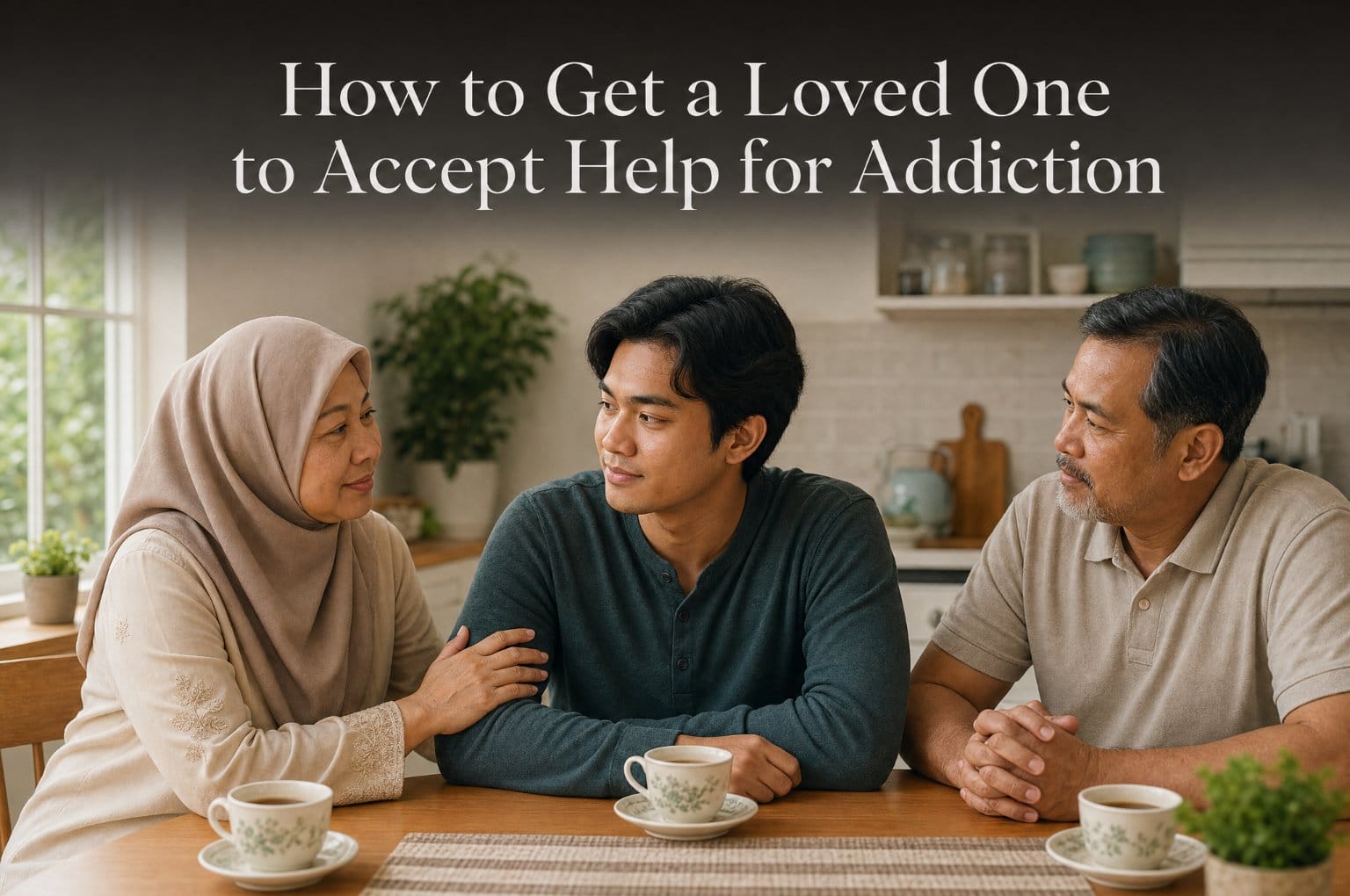
How to Get a Loved One to Accept Help for Addiction
October 16, 2026
Clinically reviewed by Adjunct Professor Dr Prem Kumar Shanmugam, founder of Solace Asia. October 2026.
Quick answer
Most people do not agree to treatment after one big confrontation. They agree after family members change how they respond to the drinking or drug use, stay calm and consistent, and offer a clear, ready next step at a moment when the person is open to it. Research on family-based approaches shows this works far more often than ultimatums or surprise “interventions”. If someone is in danger right now, call 999 or go to the nearest emergency department.
Why pressure usually backfires
When a family is frightened, the natural response is to argue, plead or threaten. Most people with an addiction have heard all of it before. Shouting tends to make them defensive, and threats that are not carried out teach them that nothing will change. Shame is a big part of addiction, so lectures often push people further into hiding their use. Families still need to speak up, with a plan for what to say and when.
What the research says works
The best-studied family approach is called CRAFT (Community Reinforcement and Family Training). Instead of confronting the person, families learn to reward sober behaviour, step back from rescuing them from the results of their use, look after their own safety, and suggest treatment at the right moment.
In a well-known trial by Miller, Meyers and Tonigan (Journal of Consulting and Clinical Psychology, 1999), 64% of families trained in CRAFT got their loved one into treatment. That compared with 30% using a confrontational “intervention” and 13% using a support-group approach alone.
A step-by-step approach
- Learn the signs and the pattern. Notice when they use, what sets it off and when they are most likely to be sober and calm. Our guide to the signs of drug and alcohol addiction can help.
- Agree as a family. Parents, partners and siblings giving different messages is one of the most common reasons families get stuck. Agree what you will say and what you will no longer do.
- Stop cushioning the consequences. Paying debts, making excuses to employers or cleaning up quietly can keep the problem going. Stepping back is not the same as abandoning them.
- Notice and reward sober time. Spend time together when they are not using. Small, warm responses to good days make a difference over time.
- Have the next step ready. Before you raise treatment, know which centre, what happens at admission and roughly what it costs. A free assessment is an easy first step to suggest.
- Choose your moment. The best time is often just after a bad night, a health scare or a problem at work, when they are sober and feeling the cost of their use.
- Keep the door open. If they say no, stay calm and try again later. Many people need to hear the offer more than once.
What to say
Speak about what you have seen and how you feel, rather than labels. “I was scared when you didn’t come home on Saturday” lands better than “You’re an addict.” Keep it short, be specific, and end with a clear offer: “I’ve found a place we can talk to. Will you come with me for an assessment this week?”
When it cannot wait
Call 999 or go to an emergency department straight away if someone has collapsed, is hard to wake, is breathing slowly, has a seizure, or talks about ending their life. Stopping alcohol or sedatives suddenly can also be dangerous, which is why heavy users should come off them under medical supervision. For emotional support, the Ministry of Health’s Talian HEAL line is 15555.
Look after yourself too
Living with someone’s addiction is exhausting. Families who get support for themselves cope better and are in a stronger position to help. Our Family Programme teaches the skills above and helps families recover alongside their loved one.
Frequently asked questions
Can I make an adult go to rehab in Malaysia?
Private residential treatment at Solace Asia is voluntary, and people do better when they have agreed to come. Families can still do a great deal to make that decision more likely, as described above.
Should we stage a surprise intervention?
Research suggests calm, planned conversations work better than surprise confrontations. If you want help planning what to say, our team can guide you.
What if they refuse?
Keep supporting sober time, keep stepping back from rescuing, and offer again at the next good moment. Get support for yourself in the meantime.
Talk to us
To talk through how to help your loved one, contact the Solace Asia team for a free, confidential consultation. We speak with families every day and can help you plan the conversation and the next step. If cost is a concern, our sister retreat Salus offers residential treatment at a lower cost, in a different residential location, maintaining Solace’s clinical standards for treatment.
Why Choose Us?
Our values make us the best addiction treatment facility in the region.
Trust
We offer addiction treatment services to clients and their families. As
the first private residential rehab in Malaysia, we set the benchmark for
ethical treatment.
Language
We have the ability to provide treatment not only in English, but also
Bahasa Melayu, Mandarin, Cantonese and even Arabic! We are truly
local yet global.
Culture
All our treatment has the Asian culture embedded in our modalities.
We are 100% locally owned and operated, unlike most centres in Asia, which
are owned by expatriates.
Academia
We don't only do Addiction Treatment, we also teach it! We are a
NAADAC Approved Education Provider. We are also on Udemy, the
worlds largest education platform.
